As daughter of two Pakistani journalists, Dr. Tabinda Sarosh was influenced by parents who dedicated their careers to human rights. At a young age, her family moved to China so her father could work for the Foreign Language Press. The experience opened Dr. Sarosh’s horizons to other cultures and experiences. “My classmates were global. The experience helped shape my worldview,” she remembers.
Her aim was always to work towards social change and justice. An early internship at an OB/GYN opened Dr. Sarosh’s eyes to the reproductive health challenges faced by women in Pakistan. “Women faced tremendous barriers in accessing reproductive health and respectful patient care,” she says. “Public hospitals were ill- equipped and underfunded.”
This early experience led Dr. Sarosh to start her career, first earning a Bachelor of Medicine, Bachelor of Surgery (MBBS) from Dow Medical College in Pakistan, and later a post-graduate diploma in nutrition. She began working in the semi-urban areas of Karachi, with a focus on marginalized immigrants. “At that time, I was documenting the experience of women accessing reproductive health care. That’s when I decided I wanted to work in public health for the rest of my life.”
In 2005, she was running women’s health programs in 118 centers run by the Aga Khan Development Network. At the same time, she joined the feminist organization Shirkat Gah. There, she managed programs on reproductive health, leading on business development and community engagement. Dr. Sarosh worked to amplify women’s voices in community-based groups, later bringing them to larger forums for national representation. She worked towards progress on goals set by the Beijing Platform, the International Conference on Population and Development, and the Convention on the Elimination of all Forms of Discrimination Against Women.
Dr. Sarosh concurrently focused on policy work, which led to a collective achievement of the passage of the Standardization of Age of Marriage to 18. As the Director of Programs at Shirkat Gah at the time, Dr. Sarosh steered the development of a research and advocacy plan, as well as partnership management.
“Patriarchy percolates through our systems and society,” says Dr. Sarosh. “We saw girls married at nine and 10. My team at Shirkat Gah were responsible for generating on- the-ground data about the social and economic status of those in early marriage. We documented the realities on the ground, the lived stories. And while the bill has now been passed, there is still a lot to do to implement the law.”
Through her career, Dr. Sarosh has worked to expand family planning services with a focus on service delivery, data systems, and health information. She led advocacy campaigns to include critical women’s health indicators in the DHIS and incorporate gender, disability, and self- care norms into key policy documents. She says the most interesting phase of her life began in 2016, when she joined Pathfinder as Country Director. Today, Dr. Sarosh is in charge of a diverse portfolio of projects across Egypt, Pakistan, Bangladesh, India, and Jordan. This work focuses on family planning, women’s economic and social empowerment, climate change resilience, adolescent and youth sexual and reproductive health, and work with communities affected by humanitarian crises.
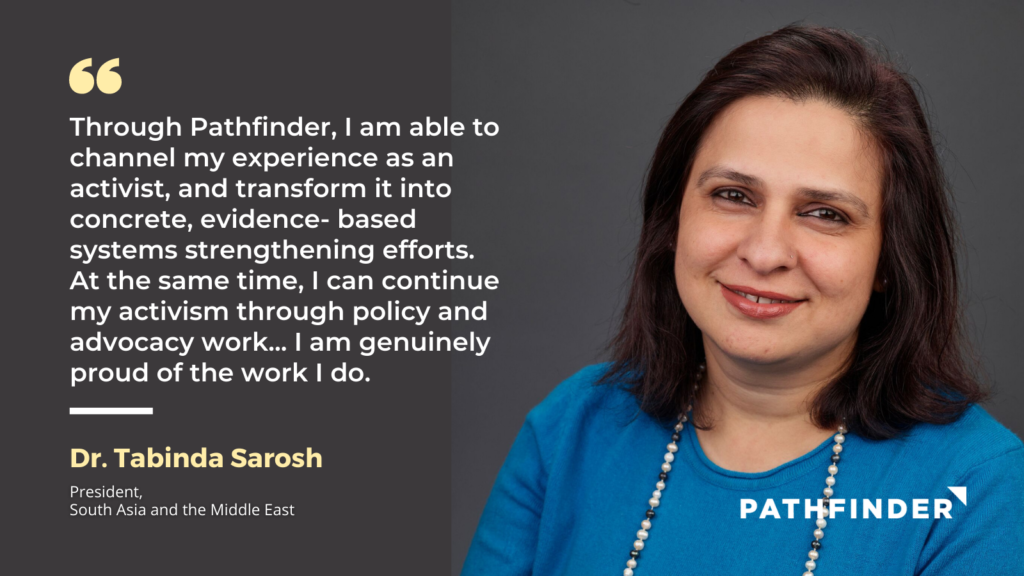
Dr. Sarosh is a tireless advocate for women’s rights. “Through Pathfinder, I am able to channel my experience as an activist, and transform it into concrete, evidence- based systems strengthening efforts,” says Dr. Sarosh. “At the same time, I can continue my activism through policy and advocacy work. It’s a journey that holds a promise of sustainability and scale, and I am genuinely proud of the work I do.”