Skip to content

Statement From Pathfinder President and CEO Lois Quam On Release of ECHO Study Results And Importance of Access to Contraception

Washington, D.C. – The results of an important clinical trial published today in The Lancet finds no substantial difference in HIV risk among women using three methods of contraception. The Evidence for Contraceptive Options and HIV Outcomes (ECHO) study was a randomized clinical trial that compared three long-acting and reversible methods of contraception – DMPA-IM, copper IUD, and LNG implant – to evaluate whether there was any difference in the risk of HIV acquisition among women using the methods.

In response to the study results, Pathfinder President and CEO Lois Quam issued the following statement:

“The ECHO trial results provide much needed high-quality scientific evidence showing no scientifically significant risk of HIV acquisition for women using three methods of contraception. This is an important development for women globally and confirms that women and girls should have access to a broad range of options for contraception along with high-quality counselling free of stigma, discrimination, and coercion. When a woman has access to, and can choose, effective contraception she is able to improve her life, choosing when and how many children to have.

“There is still much work to be done as the overall incidence rate of HIV acquisition of women in the study was high, at an average of 3.8% per year. Particularly in settings with high HIV prevalence, we must integrate HIV prevention programs as a part of family planning.

“214 million women globally wish to avoid pregnancy but are not using a modern method of contraception. What this study and our work at Pathfinder shows us is that, to achieve health for all, we must close the gap between those who wish to use contraception and those who can.”
Featured Stories & Perspectives

Beyond Participation: Ensuring Women & Communities Lead Climate Resilience

To truly build resilience in the face of the climate crisis, we must shift the power dynamics: from top-down interventions to community-led transformation—with…

Read More
Clinical Mentorship for Better Family Planning Care

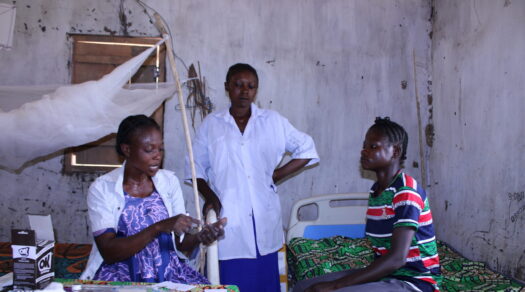
From Fear to Mastery: Clinical Mentorship for Better Family Planning Care

I Used to Fear it. Now I Master it. KIKWIT, Democratic Republic of the Congo — For years, women in Kwilu Province…

Read More
Empower Community Meeting

EMPOWER Uganda: Transforming Lives, Strengthening Systems

Cross-posted from our Country-Led in Action newsletter on LinkedIn. In Uganda, we often speak about systems strengthening, localization, and sustainable…

Read More
From Global Indicators to Local Impact: How COP30’s Adaptation Framework Can Strengthen Health Resilience

From Global Indicators to Local Impact: How COP30’s Adaptation Framework Can Strengthen Health Resilience

The Bridge Between Belém and the Clinic The Global Goal on Adaptation (GGA) now has a measuring stick. A decade…

Read More

What 500 Young People can Teach You about Work

Redefining Employability for a Changing World Employability is typically treated as a technical problem: a matter of skills gaps, training…

Read More

From Awareness to Action: A Teacher’s Fight to Keep Girls in School

Lire cette histoire en français >> In Kourfey, Niger, a problem was weighing heavily on Moussa Tahirou. As a teacher,…

Read More

The Pulse of Country-led Progress: A Conversation with Dr. Amina Dorayi 

After a hiatus in 2025, our LinkedIn Country-Led In Action newsletter is back! We explore how our country-led strategy translates into sustainable approaches that improve the health, resilience, and leadership of…

Read More

Improving Data Systems to Reach Girls with the HPV Vaccine in Nigeria

Every vaccination program hinges on a fundamental question: Do we know where the eligible population is? For the life-saving HPV…

Read More
Climate Champion Chandi - #16Days Feature

#16Days: A Climate-Resilient World is a Safer World

#16Days of Activism Against Gender-Based Violence Violence against women and girls is one of the most pervasive—and preventable—human rights violations…

Read More

From Training to Transformation: How Kano’s Health Workforce Mentorship Program is Saving Lives 

Health workforce shortages plague Kano state’s health system in Nigeria, where for every 10,000 people, there are only 3 health workers available to provide care. This critical workforce…

Read More

Overcoming Disruption, Transforming the HIV and AIDS Response: Why Community Leadership Still Matters

This World AIDS Day arrives with a powerful symbol of scientific progress: lenacapavir, the long-acting injectable PrEP that can prevent…

Read More
Woman holding seeds

Climate Champions: How Women in Pakistan and Bangladesh are Leading the Fight for Resilience

Climate change is ravaging communities across Pakistan and Bangladesh. From devastating floods and violent cyclones to prolonged droughts and lethal…

Read More