1M
people
reached through awareness events, community gatherings, and direct outreach in 2026.
443
clients
empowered with new, climate-resilient livelihoods in 2026.
118
health facilities
strengthened to withstand climate shocks in 2026.
Women and girls are at a higher risk for food insecurity, displacement, health complications, and exposure to violence when climate disasters strike. Around the world, we apply locally led solutions to climate and health resilience, delivering crucial services to women and girls while helping communities adapt to the climate crisis. We partner with women and young people to develop climate innovations based on local context and risks, elevating women and girls as climate champions who lead resilient, local, rights-based solutions to climate adaptation.
Pathfinder’s differentiators lie in our integrated, equity-driven approach to climate resilience. Through locally led implementation, evidence-driven learning, and proven, scalable models, Pathfinder delivers integrated solutions that strengthen resilience across communities, health systems, and policy environments while generating sustainable, long-term impact.
Our Pathways to Change
- Improve health system climate resilience. Health systems must maintain services during climate shocks and stressors. Resilience reduces vulnerabilities and mortality while enabling health as a pathway to equity and agency.
- Address the human impacts of climate change. Communities have agency to adapt to climate impacts. Integrated approaches combining health with livelihoods, education, and voice, reduce vulnerability and build resilience
- Promote the next generation of climate leaders. Women and youth leadership drives sustainable change. When they participate and decide, it yields systemic power shifts and lasting impact.
Our Strategic Pillars for Building Climate Resilience
- Develop or strengthen national and sub-national climate and health policies, strategies, and regulatory frameworks, and integrate gender equality and equity across these foundational documents.
- Support governments to integrate climate and health priorities into national adaptation plans, health sector strategies, and investment frameworks.
- Establish multisectoral governance mechanisms centering community voices and meaningful women and youth participation.
- Integrate climate resilience in health system performance standards, licensing, accreditation, performance management, and public investment planning.
- Integrate climate and health competencies into pre-service and in-service training for all health worker cadres.
- Strengthen organizational systems for climate informed planning, budgeting, implementation, and risk management in the health sector.
- Build capacity of community organizations and civil society for climate and health coordination.
- Develop climate-smart workforce pathways, entrepreneurship opportunities, and green jobs that advance economic empowerment, particularly for women and youth.
- Strengthen climate-resilient and gender-responsive water, sanitation, and hygiene systems with improved management and quality assurance.
- Support climate-smart agriculture and diversified food systems, enhancing nutrition and livelihood security.
- Promote access to clean energy solutions with priority for health facilities and women entrepreneurs.
- Implement ecosystem restoration and natural resource management while supporting community resilience.
- Conduct climate risk and accessibility assessments for health facilities and use findings to guide infrastructure improvements.
- Retrofit health facilities to withstand climate hazards with renewable energy and water harvesting systems, with a focus on equitable accessible for the most marginalized.
- Strengthen supply chains, ensuring medicine and equipment availability despite climate shocks.
- Develop facility-level emergency preparedness plans with staff training and community engagement.
- Co-design gender transformative service delivery models to climate-driven health and population needs.
- Strengthen health worker capacity to diagnose and manage climate-sensitive conditions (heat stress, waterborne disease, malnutrition).
- Ensure access to comprehensive, quality SRHR services in the face of climate shocks.
- Build community health worker networks to extend care to underserved populations.
- Link interventions to Pathfinder’s Women&Co, our social innovation platform for women innovators, leaders, and changemakers.
- Strengthen health information systems to capture climate and health data for real-time decision-making.
- Conduct applied research on climate and health interactions and promising interventions.
- Develop and scale climate and health innovations, including technology-driven early warning and surveillance systems, generating evidence from diverse contexts.
- Create mechanisms for systematic learning and adaptation, including research.
- Strengthen national and local capacity to access, manage, and report on climate finance, including GCF and other climate investment mechanisms.
- Support development of investment-ready climate and health projects and pipelines aligned with national priorities.
- Mobilize blended finance, impact investment, guarantees, and innovative financing mechanisms that crowd in public and private capital.
- Promote women-led, locally driven enterprises and financing models through Women&Co and other catalytic platforms.
- Strengthen climate budget tracking, results measurement, and accountability systems to ensure efficient and equitable resource allocation.
- Demonstrate scalable financing models that deliver measurable climate resilience, health impact, gender outcomes, and sustainable development co-benefits.

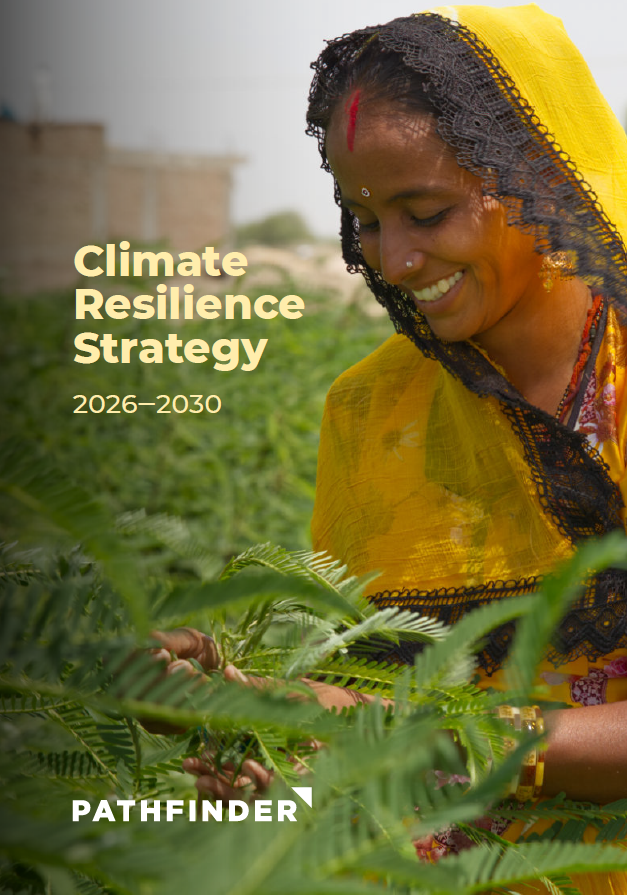
Explore our Climate Resilience Strategy
To learn more about how Pathfinder integrates sexual and reproductive health and rights into climate-resilient health systems, elevates women and youth as leaders in adaptation and decision-making, and bridges health and climate sectors to drive systemic change, read our 2026‒2030 Climate Resilience Strategy.