As COP31 opens in Antalya on 9 November, the Lancet Countdown on Health and Climate Change marks its 10th anniversary. The 2026 Lancet Countdown report is the work of 146 experts across 71 collaborating institutions tracking 54 climate indicators. The report delivers a stark reality check—that climate change is a global health emergency.
I outline below what the report found, and where Pathfinder’s work is already answering its call.
A global climate-health emergency
Ten years after the Paris Agreement entered into force, the 2026 Lancet Countdown report reaches a clear conclusion: many climate-related health harms grew faster in the last decade (2016–2025) than in the one before. Its authors call for climate change to be formally recognized and addressed as a global health emergency.
The numbers are alarming:
- Heat was associated with an estimated 710,000 deaths in 2023, a record, and for the first time the report finds that human-caused climate change is behind more than 70% of that toll.
- Extreme drought affected 51.8% of global land for at least one month in 2025.
- Heat exposure cost 573 billion potential work hours and US$1.07 trillion in income in 2025, with losses felt hardest where least has been contributed to climate change.
- The climate is becoming more suitable for dengue and malaria transmission, exposing populations and health systems that are unprepared.
But the report is also a story of solutions that work. A quarter of World Health Organization (WHO) Member States (56 of 194) now have a Health National Adaptation Plan (HNAP), up from 14 in 2015, and 47 have completed a vulnerability assessment. Laws that reference both climate and health have risen roughly 50-fold since 2000. And early warning works: between 2006-15 and 2016–25, the increase in people affected each year by storms and floods was 8.6% lower in countries with health early warning systems than in those without.
Evidence, adaptation, and clean energy are expanding, but not fast enough. At Pathfinder, our work directly supports the solutions the report calls for, turning evidence into localized impact.
Scaling resilient health infrastructure and clean energy
Health facilities are the front line of climate adaptation. When floods damage roads, storms knock out power, or water supplies fail, mothers, newborns, and children still depend on health clinics for essential care.

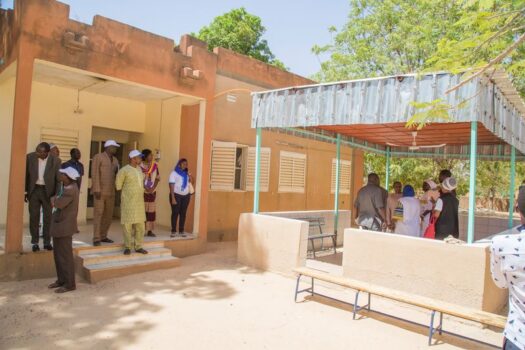
Over the last five years (2020–2025), Pathfinder has helped equip more than 2,200 climate-resilient health facilities with green energy; eco-friendly technology; green spaces; resilient infrastructure; and water, sanitation, and hygiene services. Through our recent project in Pakistan and Bangladesh supported by Takeda Pharmaceuticals Limited’s Global CSR Program, for example, 1,090 facilities adopted resilience measures and 1,075 now provide integrated climate and health services. Similarly, a Green Clinic Model we implemented in Egypt delivers climate-responsive health care, while equipping clinics with solar energy and sustainable water supplies.
The investment case is strong: investing in climate-resilient health infrastructure can yield up to a 317x return, while climate-informed early warning systems deliver a 15x return.

Yet most health clinics are not prepared to cope with climate events. Uganda’s national vulnerability assessment of 716 health facilities found that facilities do not regularly assess whether their energy systems can withstand climate emergencies. Practical renewable energy solutions can transform care. Through our recent EMPOWER project in Uganda, we supported the installation of solar panels at health facilities that previously had no electricity, enabling providers to deliver babies safely at night.
Turning policy into action: vulnerability assessments and Health National Adaptation Plans
Globally, only 47 of 194 WHO Member States (about 24%) have completed a climate-health vulnerability and adaptation assessment (VAA), and 56 (about 29%) have an HNAP. Plans on paper are not enough; they need to be financed, put into action by governments, and applied at the level where services are delivered.
Pathfinder supports countries, such as Uganda and Ethiopia, to develop HNAPs through quantified climate risk assessments that move beyond analysis to action: operational roadmaps with costed priorities, adaptation planning, and clear indicators. In Uganda, Pathfinder worked with the Ministry of Health, Makerere University, WHO, and others on the VAA and the HNAP 2025–2030, and we have worked on applying the plan at facility level so that national policy translates into what happens in the clinic. This lays the foundation for policy-driven financing and long-term action, and it speaks to the Countdown’s call to make health outcomes a core measure of success across all climate action.
Unlocking climate finance for health
The finance gap is the most ominous figure in the Lancet Countdown report. Of the 79 countries reporting adaptation plans, 48 (61%) identified health adaptation needs totaling US$3.3 billion a year. In 2024, declared international finance for health adaptation in those countries was only US$1.1 billion, one-third of the stated need.
Closing that gap takes more than advocacy. It takes countries that can design bankable, fundable proposals. Pathfinder equips government partners with the skills and tools to develop investment-ready concepts for institutional funders such as the Green Climate Fund, so that costed needs in national plans become funded projects. The Countdown also calls for more grant-based and highly concessional climate and health finance, and we agree: capacity to absorb and use finance must grow alongside it.
Community-centered adaptation: where ecosystems, health, and livelihoods meet
Climate-driven floods, extreme heat, and changing rainfall do not hit health systems alone; they hit households, water sources, and livelihoods. Some of the strongest evidence for what works comes from integrated population, health, and environment approaches that treat these connections as one system and rely on partnerships with women and young people to develop climate adaptation innovations based on local context and risk.

Through HoPE-LVB, Pathfinder and local partners worked in the Lake Victoria Basin in Kenya and Uganda, where communities depend on the lake and its resources. Over its first two phases (2011–2017), the project:
- helped communities establish more than 4,481 new latrines and influenced 9,220 households on handwashing practices;
- supported the planting of 680,768 trees across model households, health facilities, schools and public spaces;
- supported communities to draft and implement 60 local by-laws protecting fish breeding areas, water sources and health practices; and
- reported that, during the 2015 cholera outbreak around Lake Victoria, no household in its Uganda sites was affected.
These are the kinds of locally led measures that reduce exposure to waterborne disease and strengthen the ecosystems that buffer floods, and they matter more as the Countdown shows climate suitability for disease transmission expanding. Importantly, they are led by local communities: women took on leadership roles in community groups, women’s incomes grew through participation in microfinance groups and green livelihoods, and youth clubs in dozens of schools took part in conservation.
The alarm bell: a growing gap in commitment
Despite clear, high-return solutions, the report finds that political and corporate engagement is slipping:
- The share of countries addressing climate change and health in UN General Debate statements fell for four consecutive years, from 66% in 2021 to 26% in 2025.
- Only 37% of healthcare companies referred to the health dimensions of climate change in their UN Global Compact reports in 2025, down from 58% in 2023.
- Health is present in national climate commitments (93% of the 106 NDCs added to the UNFCCC registry in 2025 referenced health), but costed health adaptation needs are far from funded.
What needs to happen next
The Lancet Countdown sets out six global priorities. From our experience, five are especially urgent for practitioners and funders:
- Put health at the center of climate action: integrate health outcomes into target-setting, monitoring and finance allocation for climate programs.
- Invest in country-owned planning: complete VAAs, develop and cost HNAPs, and carry them down to districts and facilities.
- Close the finance gap: provide more grant-based and concessional finance and invest in the skills to prepare bankable proposals.
- Build data and early warning systems: connect climate and health data, because early warning already reduces impacts.
- Back community-led, gender-responsive action: resilience is built locally, with women and young people leading.