More than 200 million women and girls around the world who want to use contraception are not actually using it—even in some places where modern contraception is more readily available.1, 2
But why the disparity?
That’s what the (re)solve project seeks to understand: why women and girls who express the desire to use contraception don’t. (re)solve then applies that understanding to develop products and services that encourage women and girls who want to prevent or delay pregnancies to use contraception. The project does this by removing the barriers that inhibit contraceptive use.
(re)solve’s approach is predicated upon the fact that one size does not fit all. We customize our solutions to the different populations with whom we work in Bangladesh, Burkina Faso, and Ethiopia.
A new approach to addressing unmet need?
There is growing consensus across the family planning community that we need to change the way we approach the challenge of ‘unmet need’ for modern contraception.
We already know that factors such as social norms, lack of high-quality information, partner approval, and past experiences with the health system can negatively affect women’s use of contraception. But there is much, much more to learn about why women don’t use contraception when they want to, and how existing interventions respond (or fail to respond) to this gap between their intentions and actions.
(re)solve is a collaboration among partners that applies segmentation analysis, behavioral design, and public health insights to gain more knowledge about the needs, attitudes, and factors that influence women’s and adolescents’ family planning decisions. Alongside Camber Collective, ideas42, and the International Center for Research on Women, Pathfinder International’s (re)solve project worked to examine the needs, attitudes, and factors that influence women’s and adolescents’ family planning decisions in Bangladesh, Burkina Faso, and Ethiopia – and then developed customized solutions to support them in forming and following through on their intention to use contraception.
In each of the three countries where (re)solve works, between one-quarter and one-third of all children born were either mistimed or unintended (30 percent, 25 percent, and 37 percent, respectively).3 (re)solve focuses on the gap between women saying they intend to use a contraceptive method to prevent pregnancy– and whether they actually do.
In Bangladesh, (re)solve identified new solutions to reach garment workers, who tend to incorrectly or inconsistently use oral contraceptives, or discontinue use because of long periods of abstinence when workers live away from their partners. In Burkina Faso, (re)solve works with sexually active unmarried young women, whose unintended pregnancy rate is 57%. And in Ethiopia, (re)solve reaches postpartum women, 2.6% of whom use modern contraception one month of giving birth and 15.6% who do so six months following their deliveries.4
(re)solve embedded its solutions in existing, sustainable ‘platforms’ that offer future pathways for integration and scale —the USAID-funded Shukhi Jibon project, private pharmacies, and Marie Stopes Bangladesh clinics and communities in Bangladesh; Project Yam Yankré (“My Choice”) in Burkina Faso; and the USAID-funded Transform: Primary Health Care project in Ethiopia.
(re)solve’s four steps
The (re)solve project has four main steps: landscape analysis, behavioral diagnosis, design and user testing, and implementation.
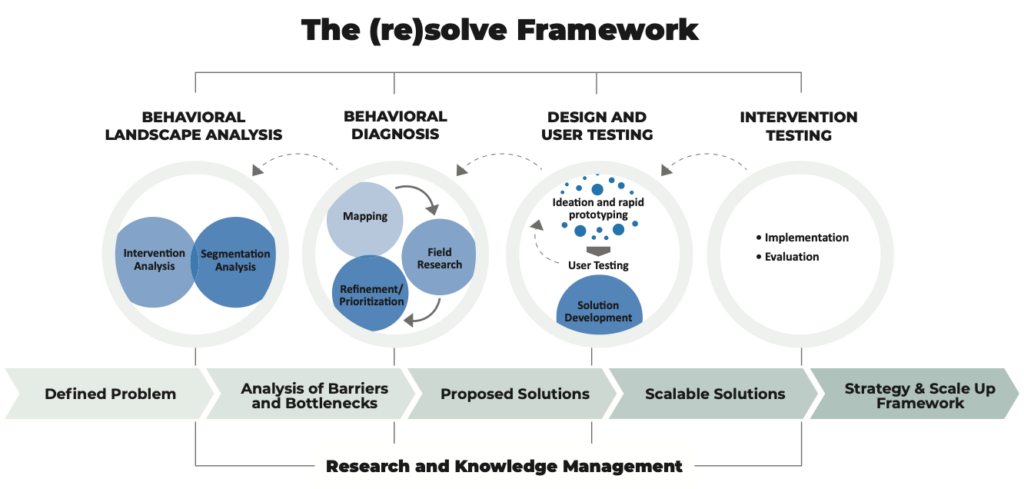
(re)solve starts with a behavioral landscape analysis, delving into different segments of the population and defining the ‘drivers of intention’ to use contraception for each of them. These ‘drivers’ include the following:
- Health Optimism: The degree of openness in her outlook on health and contraception (health proactivity, perceived provider bias, and perception of western influence on contraceptive use)
- Unmet Demand: The gap between want and use of modern contraception (for whom pregnancy would pose a problem)
- Agency: The ability and desire to make her own decisions about using contraception (perceived control/voice in health decisions, autonomy in contraceptive and reproductive decision-making, ability to decide when to have sex with partner, use of contraception without partner permission, willingness to try something new)
Then, through a behavioral diagnosis, (re)solve ‘maps’ a behavioral problem, generating hypotheses about the behavioral bottlenecks or barriers that may be inhibiting women and girls from using contraception and the underlying drivers that trigger those bottlenecks. We refute or confirm these hypotheses through research and then prioritize the behavioral barriers we want to address. We map these barriers back to the population segments we are working with.
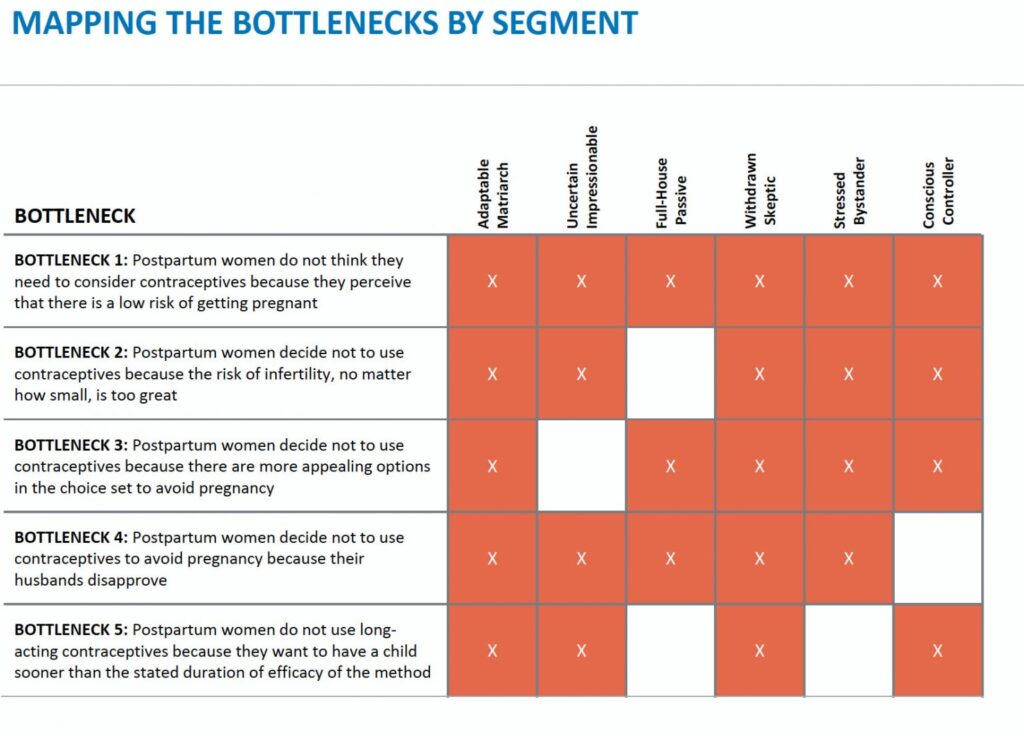
Next, we undertake a design process that leads to customized solution sets for that behavioral problem. We test and tweak the solutions with the women and girls they are meant for. This iterative approach helps to arrive at solutions women and girls will accept and use.
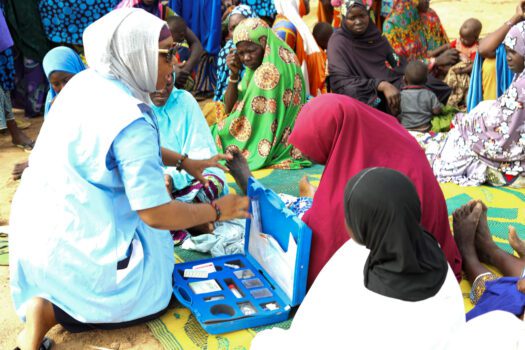
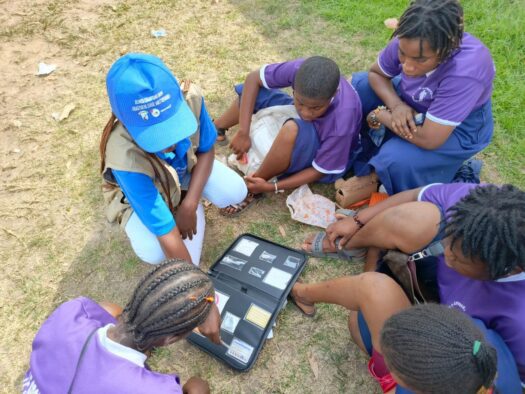
In Bangladesh, the solutions included visual reminders and stickers for pill packs; in Burkina Faso, a board game related to contraceptive decision-making and health passports; and in Ethiopia, counseling sheet, referral card, and home visit tracking tool for use by Health Extension Workers. (re)solve’s initial solutions have been extremely well received by their communities. We are currently implementing and evaluating the solutions in all three countries.
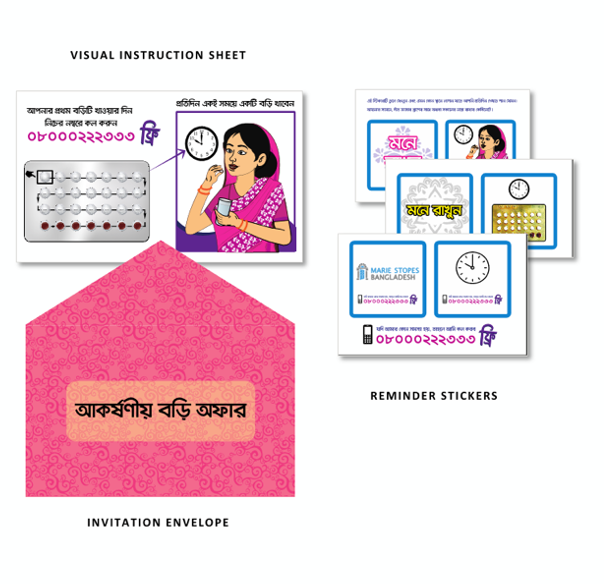
To learn more about (re)solve’s specific solution sets and how we got there, you can visit these three slide documents: Bangladesh, Burkina Faso, and Ethiopia.
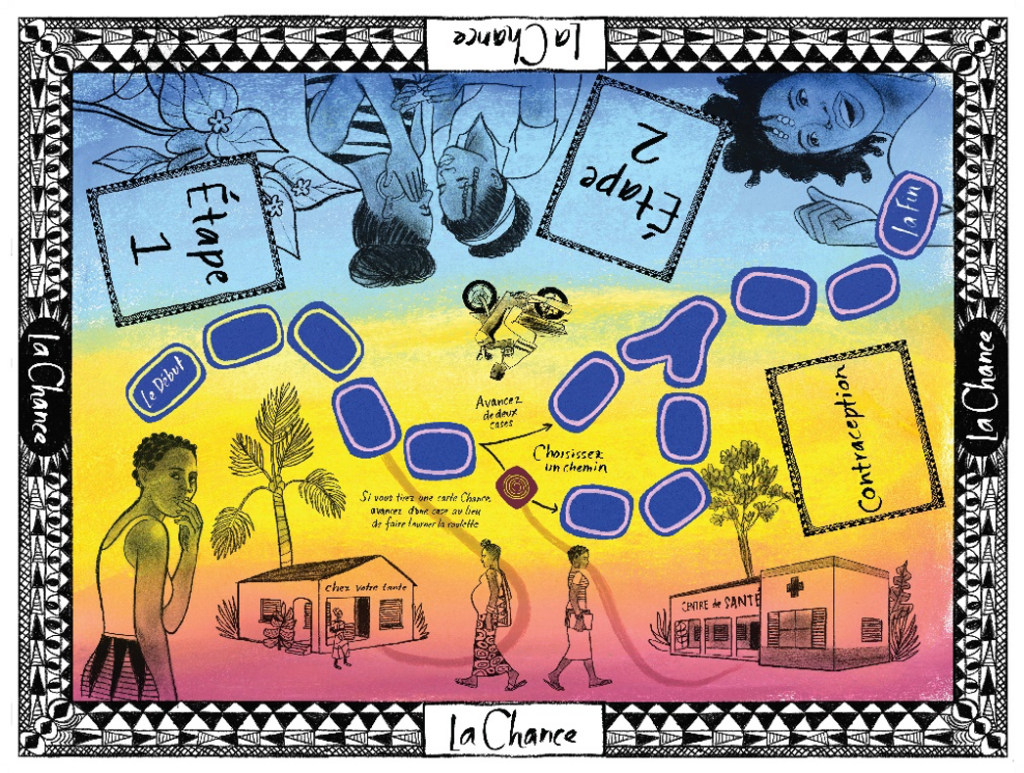
We knew that not everything we tried was going to work. When something did not work, we changed course. Throughout the (re)solve project, we tested and adapted prototypes – then evolved them to better fit the needs of our communities. When the community rejected a prototype, we discarded it and started over. At its heart, (re)solve believes that if we can get to the heart of the behaviors and other barriers that contribute to unmet need for contraception, we can unearth opportunities to improve the interventions that we know work. We can create transformative solutions that support women and girls to make crucial decisions about their bodies and their lives.
This blog is the first in a series about the (re)solve project. Read the second blog in the series: (re)solve in Burkina Faso – where art and science meet, by design.