On Earth Day, Pathfinder is sharing stories from those who experienced unprecedented flooding in Bangladesh in June and July of 2022. Pathfinder’s Advancing the Leadership of Women and Girls Towards Better Health and Climate Change Resilience initiative, funded by the Takeda Pharmaceutical Company Limited Global CSR Program, is working with flood-prone communities in building their resilience to climate shocks. Through this program, Pathfinder aims to reach 700,000 people in Bangladesh and Pakistan, boosting climate resilience and improving the health outcomes of women, girls and their communities.
Delivering in a flood – Hasna’s story
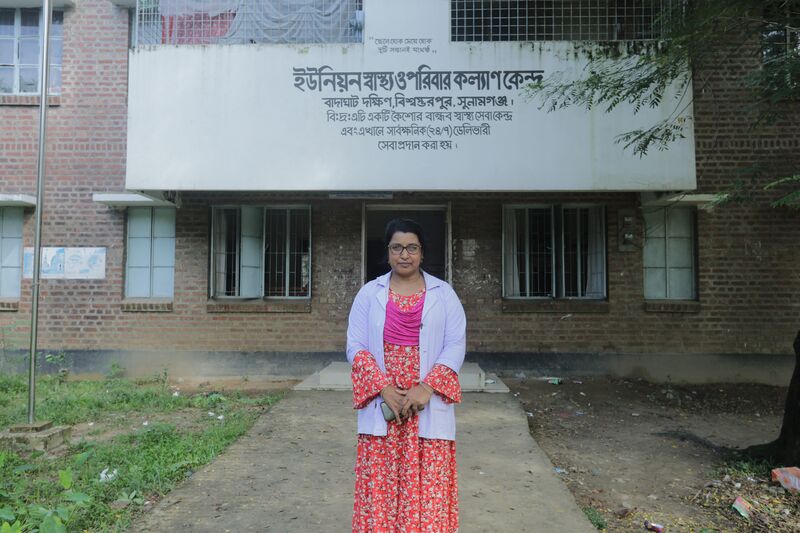
I saw the conditions and thought that it was impossible to deliver here on this boat.
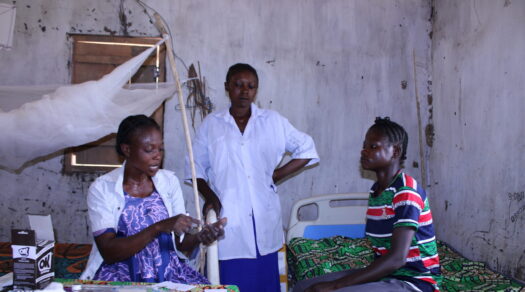
The flooding was rapid, says Hasna Akhter, a Family Welfare Visitor at Badhaghat Dakhsin, Bangladesh. “At first, it was just a mild rain, and then one night I woke up and saw the water coming up the stairs. By five in the morning, the water had rushed in, and was up to our knees.” Water flooded all the roads leading to the Union Health and Family Welfare Center, the hospital where Hasna works and lives.
The hospital had a second floor, and people started showing up in boats. Together, they hauled rice and other goods up to the upper level, and within the day, there were 15 families taking shelter. Along the way to get more supplies, a small boy on another boat cried out to Hasna. “He told me that his mother needed help and was in pain. I went to see the mother, who was on another boat. I saw her condition and thought it was impossible to deliver on the boat. I told them they must come to the hospital—she needs an IV.”
Soon after, a group of men brought the mother to the hospital. There was already a foot of water in the operating room, but the table was dry. Without electricity, and with the storm intensifying, Hasna managed to deliver a healthy baby boy. “Everyone from her family was crying, asking me to do whatever I could—there was no other place for them to go.” After the birth, the family remained, as their home was under water. “I took the family upstairs and gave them a room, but after one day, they returned to their home.”

Building Resilience
Building each community’s resilience to climate shocks takes the entire community. From using local schools as de-facto shelters to preparing health workers to adapt and continue to serve through climate shocks and engaging women in devising local solutions to climate change adaptation, Pathfinder is working across communities in flood-prone zones to comprehensively support resilience.
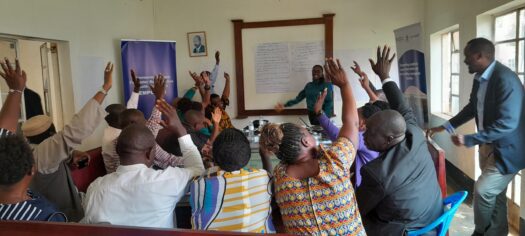
To start this work in Bangladesh, Pathfinder undertook an assessment of 530 health facilities in four districts (Sylhet, Sunamganj, Kishoreganj, and Netrokona), working to understand their needs, their level of preparedness, and the types of contingency plans they had in place for potential climate shocks. Results of this assessment will inform advocacy initiatives, with the goal of better preparing local health facilities for climate shocks.
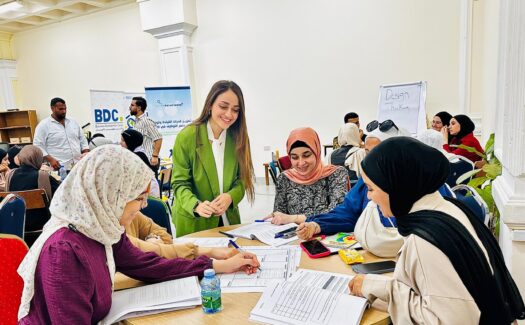
Second, Pathfinder’s community risk assessment trainings are preparing communities in responding to potential shocks. For example, Pathfinder is assessing the ability of 20 local schools to serve as shelters before the upcoming flooding season. The assessment will help to identify shortcomings. Pathfinder will then work with our local partners to fill gaps in infrastructure and logistics preparation, such as proper sanitation and menstrual supplies for women, who often find themselves without access to appropriate facilities during climate shocks.
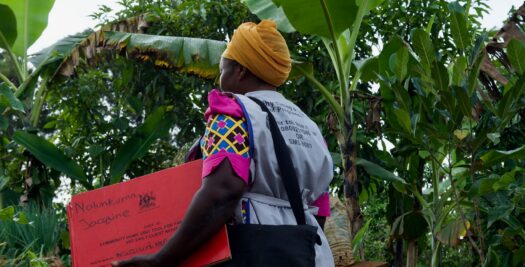
Finally, Pathfinder is mapping pregnant women in communities and reaching them directly through individual outreach. Pathfinder staff are preparing these women for safe deliveries, and discussing their options if they were to face delivery during flooding. These conversations are specific to each woman and include financial needs and logistics, like whether families have access to a boat and if there are potential blood donors in their families or communities. These types of preparatory conversations are critical, as health workers can’t always reach communities during a climate emergency.
Pregnancy in a flood – Selina and Dulal’s story

We only could stay at the madrasa and school where there was no proper toilet or food. All of the people in our village went there to stay during the flood.
“On the day of the flood, we were asleep,” says Dulal Ahmed . “When we woke up, we saw that the water was ankle high.” Worried about his wife, Selina, he called his in-laws. The water hadn’t reached them yet, so he arranged a boat to their home. But by the next morning, their house was also flooding, so they went by boat to the local madrasa.
“We were there for three days, and our own house was submerged in water. But at the madrasa, we faced a lot of problems. There was no proper bathroom. We had to use curtains, as there were no doors. And everyone had to use the same bathroom, both men and women. We had no proper food to eat, no water to drink. After a few days, relief came. But those days were horrible for us, especially for a pregnant woman. There was no place to sit or sleep— people had come with everything they could save.
Adds Selina, “If a shelter is built it needs to be built on higher ground. Even our community hospital was under water when the flood hit. If these places, which are essential to our community, were built on higher ground, then doctors and nurses could provide care during such a disaster.”
The shelter is inadequate – Mohamed Nurul Amin’s story

Even our older generation, our grandfathers and their grandfathers, have never seen such flood themselves.
Mohamed Amin is a ward member of Companiganj, Sylhet District. “As a ward member and a representative of the people, I could not stay in my own house during the flood,” he says. “I took shelter at the madrasa because we don’t have any official shelter in our village. But this shelter is inadequate for the people… 150 families took shelter at this place, but there was no adequate place to sleep, not even a place to sit. Mothers took their children and walked all night.”
Mohamed describes how hard it was, particularly for women. “If 150 families stay here, and each family has 5 members, there are 700 people. The most important issue is that our women and girls, as well as the elderly, suffered because they didn’t have adequate facilities. So, the men built a toilet for the women and girls on the roof of the madrasa.”
“Another woman from my village was here. While here, she started to experience labor pains. But there was no place to deliver a baby—it was so crowded that we couldn’t secure a place to deliver the child. We took the pregnant woman to a nearby house in a boat. The house was flooded, but at least there was a bed where she could lie down and deliver.”
Learn more about Pathfinder’s climate and health resilience work.
More Voices
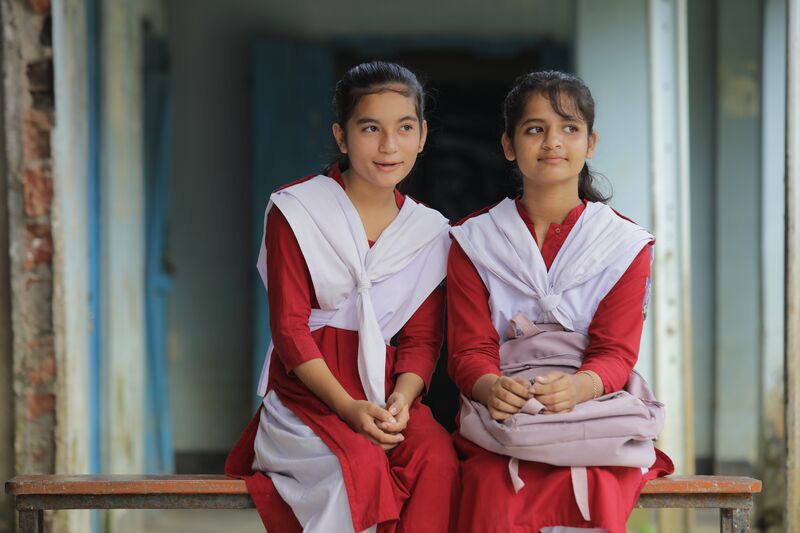
I could have never imagined flood water would come in our house.
Tasnim Ahmed Jebin and Shahjadi Mahbuba, Lopjan Choudhury girls’ high school students
For young girls who got their period, problems for them were even worse. There were no toilets to clean ourselves. Not even any pharmacy was open for us to buy sanitary pads.
Iqra Zaman Rumi and her sister Israt Jahan Urmi


Everything was washed away like the delivery room, delivery equipment. Also, the service provider, who [usually] stayed there or came to provide service, was not able to come. To deal with this challenge, we suggested that we obtain boats, so in the future, we can give emergency services quickly… But we will not be able to cover all areas. No matter how sincere we are, when faced with a disaster, the main challenge is inaccessibility.
Abul Mansur Muhammad Ashjad, Sylhet, Union Health and Family Planning Officer
Even if we wanted to provide health services, when the water level was this high, it was quite impossible, we could not come here, there was no network, nor electricity.
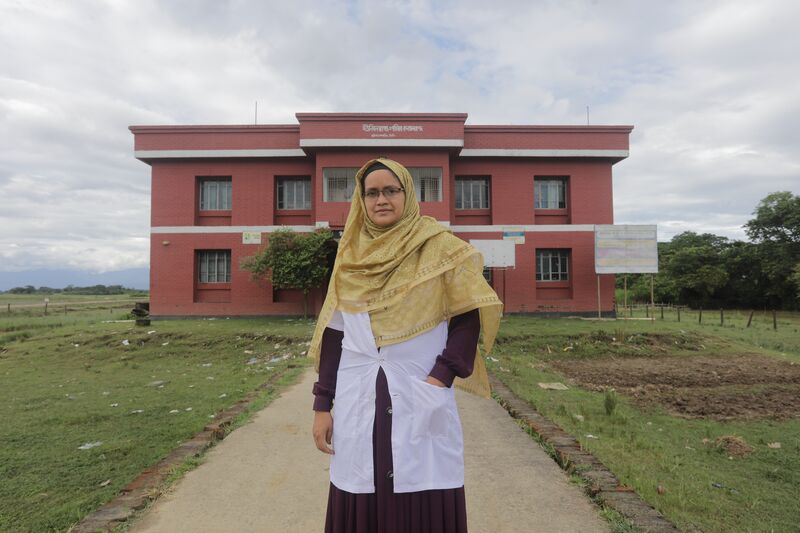
Sharmina Akter, Deputy Assistant Community Medical Officer at Telikhal Family Welfare Center, Union Health and Family Welfare Center
Watch our film, Women and Girls on the Frontlines of Climate Change, to learn more about how Pathfinder is working to support resilience across areas of Bangladesh and Pakistan prone to climate shocks.