Across India’s Bihar and Maharashtra states, married couples are joining together to reach young couples with modern contraception.
This story is part of a multi-part series on Pathfinder’s Youth Voices for Agency and Access (YUVAA) project:
- Part 1: Engaging Couples, Engaging Communities — Learn about YUVAA’s program model, and see how it works in practice
- Part 2: Meet Vaishali and Subash, Yuvaakaars for life! — Learn more about YUVAA’s social entrepreneurship component, as well as its gender-synchronized approach
- Part 3: YUVAA’s Digital Innovations — Learn about YUVAA’s digital approaches, including specifically designed mobile apps, VR interventions, and social behavior change campaigns
- Part 4: In India, Married Couples Teach the Next Generation About Contraception and Family Planning — A ‘day in the life’ of two Yuvaakaars, as they work in their own community to bring modern contraception to married couples

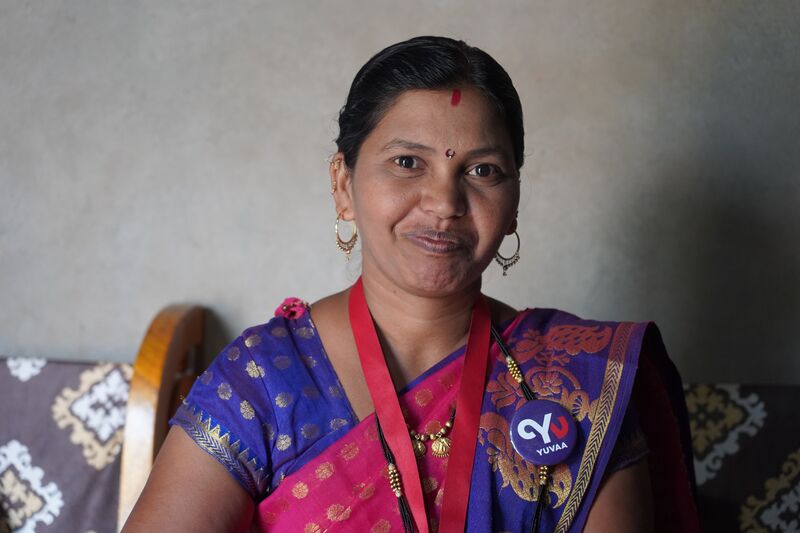
Vaishali Chaugule is a force to be reckoned with it, and you know it from the first moment you meet her. Far faster than a human can translate, Vaishali launches into an animated story about herself, her family, her husband Subash, and her work with Pathfinder’s YUVAA project.
“For the last six years,” says Vaishali, “I worked with Dharma Life.” (Dharma Life is a local partner to Pathfinder in implementing the YUVAA project). “But because of the YUVAA project, Subash and I have started to work together. It’s shifted our relationship. Subash started to understand the work, and as we worked together, we started to develop more financial stability. Now, we have a new identity as a couple—as a YUVAA couple. More than this, family planning wasn’t that readily available in the places we are going. Villages have been happy to have us, to host us.”
Social Entrepreneurship with YUVAA
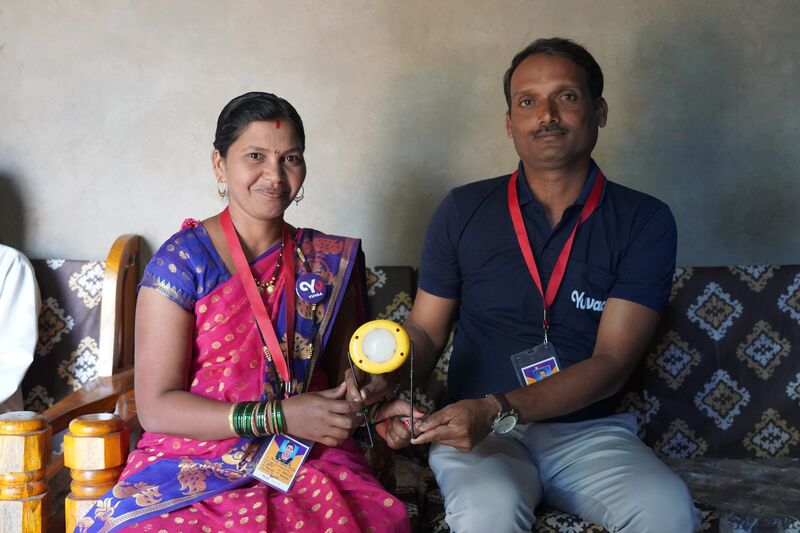
A ‘product basket’ gives Yuvaakaars the option to reach communities with needed goods while promoting contraceptive access
Pathfinder’s YUVAA project combines social entrepreneurship and innovative communication approaches, working to improve access to contraceptive choices and positively shifts gender and social norms by delivering customized family planning messages to young couples in 10 districts of Bihar and Maharashtra.
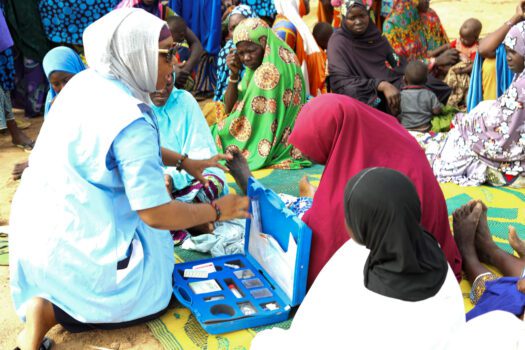
The social entrepreneurship piece is a unique one. Couples are able to not only get training on family planning and modern contraception, but they also learn about entrepreneurship. Yuvaakaars are then provided ‘product baskets,’ which contain a range of useful household goods like sanitary napkins, baby formula, and solar-powered lamps, but also contraceptive options like pills and condoms. Because couples are ‘mapped’ to work with local communities, they are able to bring these products to young people’s doorsteps, increasing the convenience and accessibility of the contraceptive options. When they sell a product, they keep their earnings and use them as they like.
Before working with YUVAA, Vaishali worked on another project where she taught basic internet skills in four villages, as well as basic mobile literacy. That work helped her have stellar results with YUVAA, and she is the top entrepreneur in the entire district. “Because of this work, I got to travel to Delhi!” she exclaims.
A gender-synchronized approach
Building gender equity through engagement of couples and communities

Yuvaakaars identify and engage young women and men in gender-transformative counseling, focusing on the benefits of gender-equitable relationships, couples communication, shared decision-making, and family planning. Because Yuvaakaars are couples themselves, they are often able to make deeper inroads into communities, sometimes connecting separately with young men and women, and sometimes connecting together.
“With YUVAA,” says Subash, “we have been able to bring so much information. Because of the program, behavior change is happening, especially among the males.” Vaishali adds. “Before, generally, females were always worrying about family planning. But now, change is happening. Now, they are aware of the different methods. They are aware of healthy timing and spacing [of pregnancies]. They have more information, more agency.”
Subash and Vaishali worked as a team, thinking of new ways and places to reach the communities. “I’m not shy about this work. Why be shy?” says Vaishali. Subash laughs as his wife is talking. “She sold *so many* condoms,” he says. “She pitched to self-help groups. She created her own team.” “Yes, I leveraged self-help groups,” she adds. “I convinced them about our work, I built relationships.”
“Together,” adds Subash, “we worked with community groups. I went to festivals, or other informal gatherings.” Today, Vaishali has obtained a license to open up her own shop, selling anything she wants. “But we will continue to include contraception,” she says.


Indeed, the work hasn’t just reached the community— has built Subash and Vaishali’s own relationship. “We were given the platform,” says Vaishali, “and we will continue to do this work.” For Subash, it has started to shift the way he thinks about reproductive health. He admits he didn’t consider this rights work at the onset. “But now,” says Vaishali, “he’s getting close to 100% believing that women’s’ rights and family planning is a human right!” “Now,” adds Subash, “men and women are making these decisions together.”
What does their grandpa, Yashwant, think? Loosely translated, “They are rocking,” he laughs! “They don’t fight. I’m so proud of them.”
Ultimately, Yuvaakaar couples like Vaishali and Subash are working to shift individual, couple, family, and community practices and perceived social norms that create and reinforce gender inequality, impacting young people’s reproductive health.
Says Vaishali, “If people have the will and the ability, they can do ANYTHING! And women aren’t less than any man. If you give me more incentive, I will do more!