Versión en español abajo | English version below
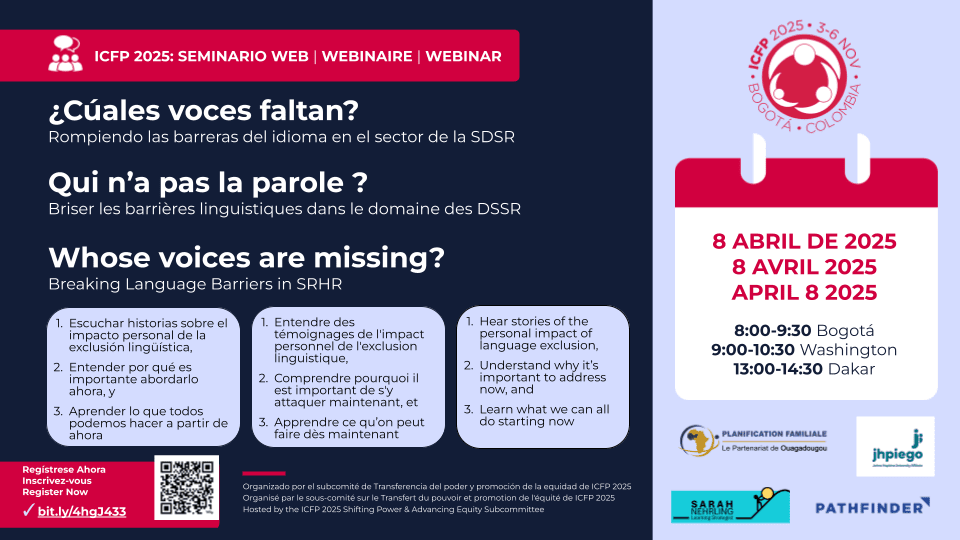
Qui n’a pas la parole ? Briser les barrières linguistiques dans le domaine des DSSR
8 Avril 2025 | 9:00–10:30 AM ET | 8:00-9:30 Bogotá | 13:00-14:30 Dakar
S’INSCRIRE AUJOURD’HUI
Au sein de la communauté des professionnels travaillant sur les droits et santé sexuels et reproductifs (DSSR), la dominance de l’anglais exclut souvent des voix importantes. Comment pouvons-nous aller au-delà de l’utilisation par défaut de l’anglais et tendre vers une plus grande inclusivité linguistique ? Pourquoi est-il essentiel de s’attaquer à ce problème maintenant ?
Organisé par le sous-comité sur le transfert du pouvoir de ICFP 2025, ce webinaire interactif explorera la manière dont la dominance de la langue anglaise affecte de nombreux professionnels des SDSR et partagera des approches concrètes pour une plus grande inclusion. Une interprétation bidirectionnelle en anglais, français et espagnol sera disponible.
À quoi s’attendre :
✅ Perspectives des pairs : À travers les expériences des professionnels francophones et hispanophones DSSR, apprendre comment la domination de la langue anglaise a un impact négatif sur de nombreux membres de notre communauté.
✅ Meilleures pratiques pour l’inclusion linguistique : Apprendre des approches simples et à bas coût que les individus peuvent mettre en œuvre immédiatement pour rendre le travail plus inclusif sur le plan linguistique.
✅ Mise en pratique : Participer à des séances en petits groupes pour essayer des outils comme DeepL et une liste de vérification pour l’inclusion linguistique dans la planification d’événements.
Pour en savoir plus sur le sous-comité sur le transfert du pouvoir de ‘ICFP 2025, consultez le site. Pour plus d’informations sur ce sujet, lisez l’article ci-dessous.
COMMENTARY
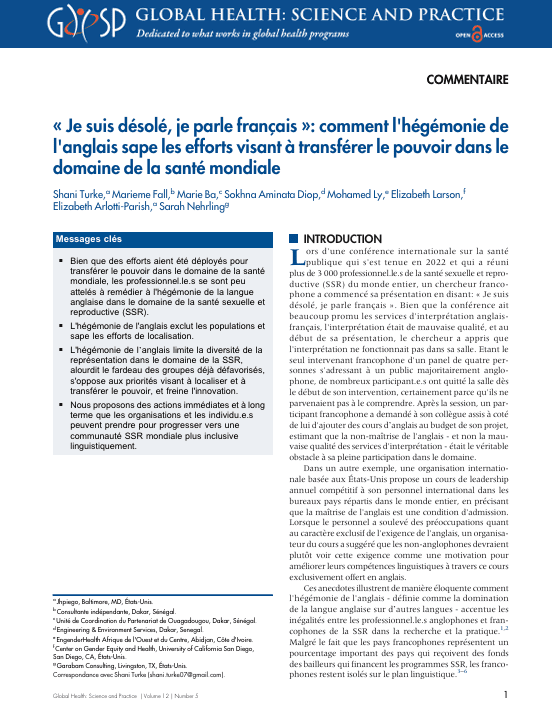
« Jesuis désolé, je parle français »: comment l’hégémonie de l’anglais sape les efforts visant à transférer le pouvoir dans le domaine de la santé mondiale
Lire en français | Read in English
Co-écrit par Shani Turke, rédactrice technique senior – francophone, Pathfinder.
¿Cúales voces faltan? Rompiendo las barreras del idioma en el sector de la SDSR
8 Abril de 2025 | 9:00–10:30 AM ET | 8:00-9:30 Bogotá | 13:00-14:30 Dakar
REGÍSTRESE HOY
Dentro de la comunidad de salud y derechos sexuales y reproductivos (SDSR), el dominio del idioma inglés muchas veces excluye voces clave. ¿Cómo podemos ir más allá del uso predeterminado del inglés y avanzar hacia una mayor inclusión lingüística? ¿Por qué es fundamental abordar este tema ahora?
Organizado por el subcomité de Transferencia del poder de ICFP 2025, este seminario web interactivo explorará cómo el dominio del idioma inglés afecta a muchos profesionales de la salud y los derechos sexuales y reproductivos y compartirá enfoques concretos para una mayor inclusión. Se ofrece interpretación bidireccional en inglés, francés y español.
Qué puede esperar:
✅ Perspectivas de compañeros: A través de las experiencias de profesionales francófonos e hispanohablantes SDSR, aprenda cómo el dominio del inglés afecta negativamente a muchos en nuestra comunidad.
✅ Mejores prácticas para la inclusión lingüística: Aprenda enfoques sencillos y de bajo coste para hacer que nuestro trabajo sea más inclusivo desde el punto de vista lingüístico.
✅ Práctica: Participe en sesiones de trabajo para probar herramientas como DeepL y una lista de verificación de inclusión lingüística para la planificación de eventos.
Obtenga más información sobre el subcomité de Transferencia del poder del ICFP 2025. Para más información sobre este tema, lea el siguiente artículo.
COMMENTARY
“Je suis désolé, je parle français”: Cómo la hegemonía inglesa socava los esfuerzos por cambiar el poder en la sanidad mundial
Read in English | Lire en français
Coautora: Shani Turke, Redactora Técnica Senior – Francófona, Pathfinder.
Whose Voices are Missing? Breaking Language Barriers in SRHR
April 8, 2025 | 9:00–10:30 AM ET | 8:00-9:30 Bogotá | 13:00-14:30 Dakar
REGISTER
Within the Sexual and Reproductive Health and Rights (SRHR) community, English language dominance often excludes key voices. How can we move beyond defaulting to English and towards greater language inclusivity? Why is it critical to address this issue now?
Hosted by the ICFP 2025 Power Shifting subcommittee, this interactive webinar will explore how English language dominance impacts many SRHR professionals and share concrete approaches for greater inclusion. Bidirectional interpretation in English, French and Spanish provided.
What to Expect:
✅ Peer Perspectives: Through the experiences of Francophone and Hispanophone SRHR professionals, learn how English language dominance negatively impacts many in our community.
✅ Best Practices for Language Inclusion: Learn simple, low-cost approaches to make our work more linguistically inclusive.
✅ Hands-On Practice: Join breakout sessions to try tools like DeepL and a language inclusion checklist for event planning.
Learn more about the ICFP 2025 Power Shifting subcommittee.
For more information on this topic, read the article below.
COMMENTARY
“Je suis désolé, je parle français”: How English Hegemony Undermines Efforts to Shift Power in Global Health
Read in English | Lire en français
Co-authored by Shani Turke, Sr. Technical Writer – Francophone, Pathfinder.