At 15, Fausta gave birth to her first child. By 23, she had four. Like many girls on Uganda’s Bussi Island, Fausta felt pressure to marry young and grow her family fast.
“Because I was always pregnant,” says Fausta, “I was sick all the time. I had trouble caring for my family. I needed to support them, but I couldn’t work. I was too weak.”
Today, everything is different. Fausta kneels between rows of lush green plants. Sweat collects on her forehead as she concentrates on her graft—joining an orange and lemon tree. Fausta is one of the nine women that run the Mirembe tree nursery cooperative. These women are trailblazers. They do work traditionally reserved for men. With support from the HOPE-LVB project,* they do it better.
Three things you should know about Fausta’s remarkable tree nursery:
1. TREES ARE JUST THE START
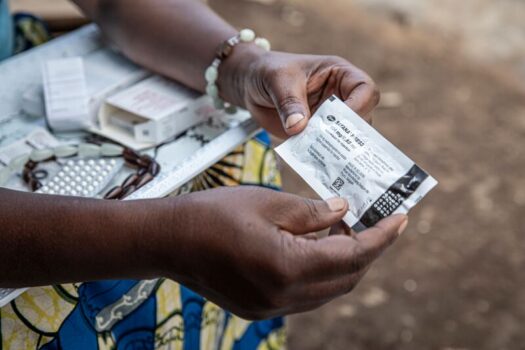
Every member of the group completed reproductive health and conservation training, conducted by Pathfinder and our environmental partner, Ecological Christian Organization. Right away, the women started the nursery, planting trees to replenish their depleted forests. While they worked, they discussed the benefits of contraception. Women like Fausta—who wanted desperately to prevent pregnancy—learned they had options.
“Before my training,” says Fausta, watering a row of seedlings, “I didn’t know the truth about family planning. I heard bad things—that it gives a woman cancer.” After learning the facts, Fausta spoke to her husband, Paul. “We agreed we could not afford another child. Together, we decided we wanted to use family planning.” Fausta is proud. “Family planning is the greatest thing in my life.”
2. WITH MONEY COMES POWER
Fausta’s nursery is abundant with cash crops—25,000 passion fruit seedlings, 7,000 coffee plants, and rows of trees perfect for building boats. Last year, the women sold their harvest for 500,000 shillings. That’s nearly $200—a substantial amount of money for families suffering extreme poverty. After splitting their profits, the women returned home with income for their families. Imagine how important this money is.
Pathfinder recognizes that these opportunities for income generation can increase women’s ability to make decisions about how their resources are used. Maye, the chair of Fausta’s group, agrees. “Because of the nursery, women no longer have to ask for everything from our husbands. To rely entirely on them and what they say. We can decide what we need for our children’s wellbeing. We can get it.”
3. MEN ARE LENDING A HAND
Fausta’s nursery was started by nine amazing women. Today, a group of men stands beside them. “Our husbands saw what we are doing and wanted to get involved,” says Fausta. “Paul and I work together in the nursery now. We have divided responsibilities. We join hands.”
All the men have completed the project’s training. “The husbands have learned things,” says Fausta. “They no longer believe we want to use family planning to go with another man. They no longer put pressure on us to have children.”
That means women in Fausta’s nursery—and the six other nurseries supported by the project—have freedom to make their own choices. They have freedom to manage their natural resources by planting trees that grow strong and healthy, like their children.
“I never imagined I could have such knowledge and skills,” says Fausta. “I feel ready to teach others. I will do it with courage. Because I am a strong woman, and this is my profession.”
*The Health of People and Environment Lake Victoria Basin project is led by Pathfinder with local communities and partners—Ecological Christian Organization, in Uganda, and OSIENALA-Friends of Lake Victoria, in Kenya. The project is funded by individual donors, the John D. and Catherine T. MacArthur Foundation, The David and Lucile Packard Foundation, and USAID.