Pathfinder leverages over six decades of experience with leading global and muti-country projects. As Director of Multi-Country Unit Projects, and a Pathfinder of 25 years, I have long believed that locally led interventions implemented by local teams with deep understanding of the contexts in which they work yield the strongest results.
This might seem obvious, but it is a centralized—usually US-based—team that tends to lead multi-country projects across geographical regions, cultural settings, and gender diversities. This is quite often achieved without taking the lived experiences of marginalized people and communities into account. Through our decades of experience, we know that this approach is not effective. Successful multi-country projects must strike a balance between building robust, collaborative relationships among teams for knowledge-sharing across countries while leaving ample room for local teams to lead tailored, innovative interventions in their home countries.
This locally led approach to multi-country project management is reflected in Pathfinder’s country-led strategy: Our programs, budgets, projects, and decision-making are centered in the countries where we work and supported by our global network of Pathfinders. Our local teams partner with their country governments, universities, grassroots organizations, and other stakeholders to drive effective, sustainable solutions to their communities’ most pressing challenges.
And often, it’s partnership with the younger generations—the people who stand to inherit their communities’ challenges—that inspire the greatest change.
Nigerien Youth Lead the Way

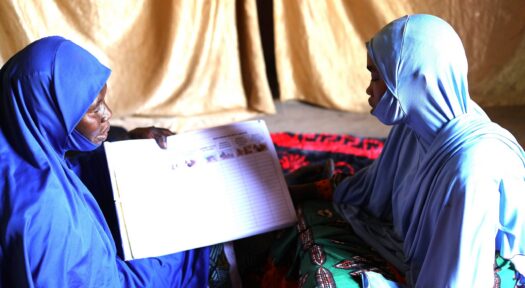
For example, in Niger, through a consortium led by IMA World Health, Pathfinder implements MOMENTUM Integrated Health Resilience (MIHR). In August 2023, MIHR recruited 30 young people (10 women and girls, 20 men and boys), ages 15–24, from existing youth associations to form two Youth Community Action Teams (YCATs) for strengthening health system resilience in Doutchi Health District. MIHR then supported the YCATs in conducting participatory action research focused on young people’s use of health facilities, including the factors that promote or prevent their use.
In February 2024, the YCATs—which had grown to 56 members (24 women and girls, 32 men and boys)—used the results of their research to inform the development of an annual action plan. The action plan focused primarily on expanding access to sexual and reproductive health care information and services for young people, preventing and responding to gender-based violence, and strengthening their own capacities for advocacy. MIHR accordingly provided training to YCATs on key concepts related to these areas of work. MIHR also trained health providers to strengthen their capacities for providing youth-friendly services and caring for survivors of gender-based violence.
YCAT member Saoudé Moussa, 19, recounts how her worldview shifted after participating in interactive learning sessions with health workers through MIHR:
“Previously, I hadn’t used reproductive health and family planning services; we often shared negative information about family planning services with peers. This first field experience has enabled me to acquire new knowledge about the benefits of family planning through the rich explanations given by our trainer. I’ve just learned for the first time that family planning also benefits children by prolonging breastfeeding, reducing childhood illness and death, and giving parents more time and resources to meet each child’s needs. It is also a factor in promoting equality between men and women.”
Now, MIHR is assisting YCAT members in connecting with administrative and health officials in Doutchi health district to present their annual action plans, develop quarterly implementation plans, and finalize data collection tools. The YCATs are also meeting with village watch committees who report cases of gender-based violence to introduce YCAT activities and advocate for young people’s participation in the committees.
I am particularly excited to see the impact these young people will make in the Doutchi health district , because I’ve seen youth-led, community-driven action in Niger achieve phenomenal results just within the last decade.
During my tenure as Project Director for the USAID-funded, global Evidence to Action (E2A) Project, Pathfinder worked with university students to implement the University Leadership for Change (ULC) initiative in Niamey, Niger. E2A cultivated the leadership skills of students at the Abdou Moumouni University as champions for sexual and reproductive health by involving them in decision-making, leading behavior change activities, and initiating youth-friendly services at the university. By the end of 2015, 53 trained peer educators reached 1,581 fellow students and 567 young people in surrounding communities with information on adolescent and youth sexual and reproductive health.
These young leaders didn’t just stop at educating their peers in Niamey. When they traveled back home to their own communities, they continued to informally serve as educators, bringing sexual and reproductive health information to their friends and neighbors. Inspired by the peer leaders’ self-motivation to continue the ULC program, the government and NGOs partnered to scale up the intervention to new settings across Niger, including three new university campuses in Zinder, Maradi, and Tahoua regions in 2016.
Then, in 2018, E2A worked with government counterparts and ULC student leaders to adapt the university-based program to 80 communities in the Matamèye, Mirriah, and Magaria districts of Zinder, creating a new cadre of youth leaders in these rural areas. ULC youth leaders at the University of Zinder served as their supervisors, mentors, and friends.
One of the most rewarding aspects of this approach is its sustainability. Peer leaders from Niamey and Zinder initiated their own student-led NGOs for sexual and reproductive health behavior change to continue their work both on and off campus. Today, these NGOs collaborate with USAID’s Sahel Human Voice in Governance Activity (SHIGA) program, UNFPA, the Ministry of Youth and Sport, the National Youth Council, and the GURI VIE MIEUX Foundation on raising awareness on advancing young people’s sexual and reproductive health and rights.
Supporting young people to become agents of change in their communities—and seeing them empower their peers to do the same—is a great privilege of my work at Pathfinder. Another privilege is working with our trusted local partners to implement multi-country projects who guide the way to effective, sustainable scale-up.
This story is part of our LinkedIn newsletter series, Country-Led in Action with Pathfinder International, where we delve deep into our country-led approaches, showcasing how our local leaders, teams, and partners are taking the helm in global health and development—leading the strategies, programs, and investments that drive impact in the communities we serve. From navigating complex partnerships to overcoming systemic challenges, we’ll offer practical insights, inspiring success stories, and candid lessons learned about how global organizations can localize effectively.